
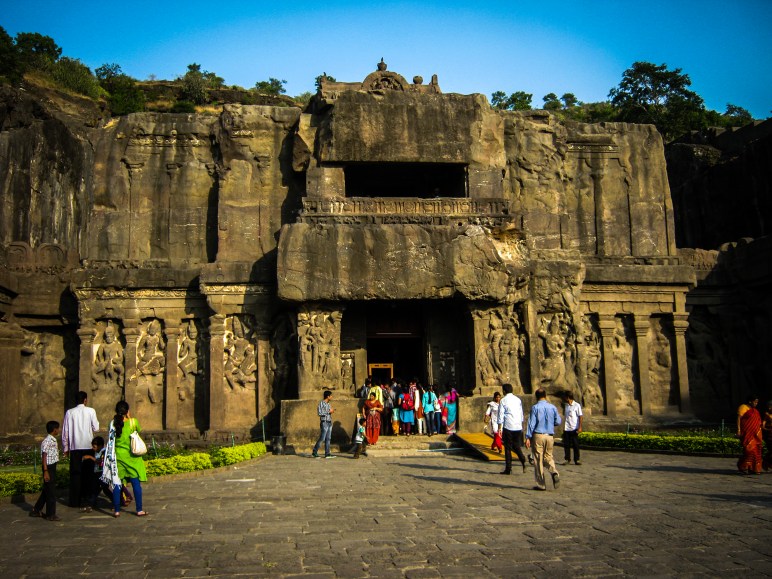
The Ellora caves, locally known as ‘Verul Leni’ is located on the Aurangabad-Chalisgaon road at a distance of 30 km north-northwest of Aurangabad, the district headquarter. Ellora represents one of the largest rock-hewn monastic-temple complexes in the entire world. It is also world famous for the largest single monolithic excavation in the world. The hills in which the caves are hewn, forms part of the Sahyadri ranges of the Deccan and dated to the Cretaceous era of the Geological time scale (about 65 million years ago)
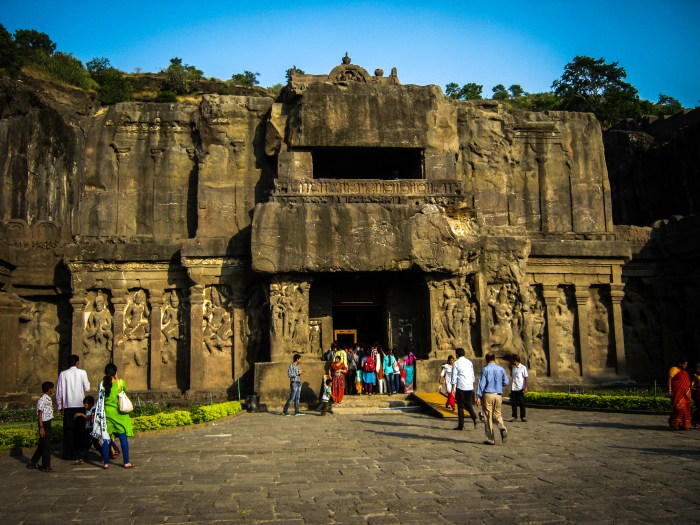
The caves are excavated in the scarp of a large plateau, running in a north-south direction for nearly 2 km, the scarp being in the form of a semi-circle, the Buddhist group at the right arc on the south, while the Jaina group at the left arc on the north and the Brahmanical group at the centre.
At Ellora there are 34 caves in all: 12 Buddhist caves (500-750 AD), 17 Hindu caves (600-870 AD) and 5 Jain caves (800-1000 AD). The caves are numbered roughly chronologically, starting with the oldest Buddhist caves at the south end.
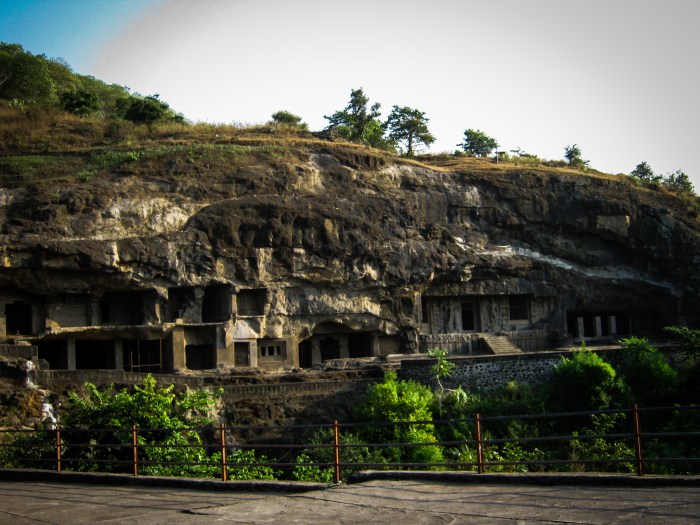
The caves are hewn out of the volcanic basaltic formation of Maharasthra, known as ‘Deccan Trap’. The term trap being of Scandinavian origin represents the step like formation of the volcanic deposits. The rock formation, on weathering has given rise to the appearance of terraces with flat summits. At Ellora, one can also have a glimpse of the channels (near Cave 32) through which the volcanic lava once flowed.
The hill also supports several streams, the prominent among them being the Elaganga, which drains into the Shiv, a stream of the Godavari river system. The Elaganga is in its full vigour during the monsoon, when the overflowing waters of a barrage in the upstream near Mahismati allows the gushing waters to land at “Sita-ki-nahani” near Cave 29 as a crashing waterfall.
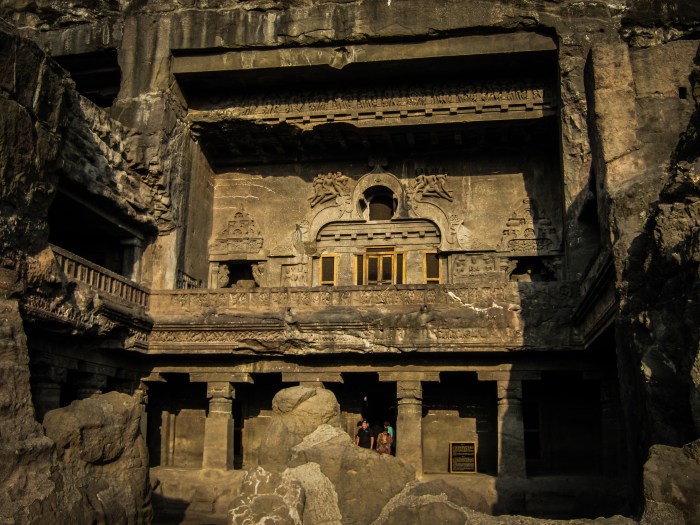
The importance of Ellora during the early centuries of the Christian era is also understood by the findings of coins of Satavahanas, the ruling dynasty during the period. The Satavahanas had their capital at Pratishtana (modern Paithan). Ellora being located on the ancient trade route connecting the western ports on the Arabian sea like Sopara.
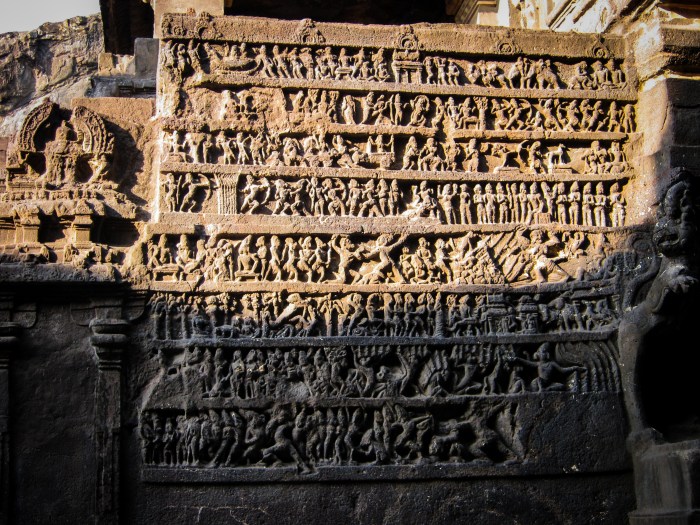
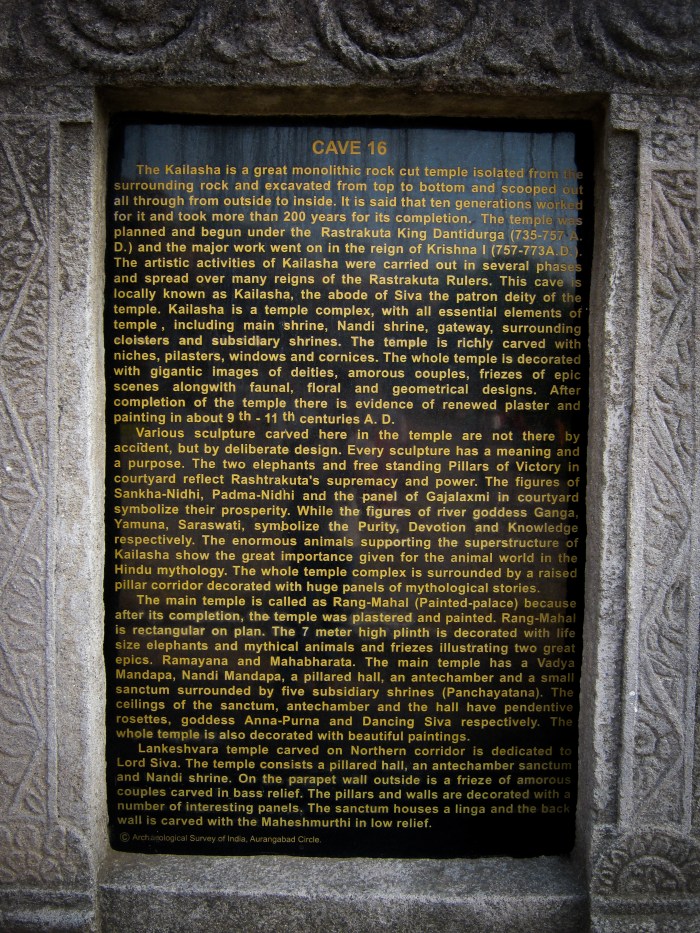
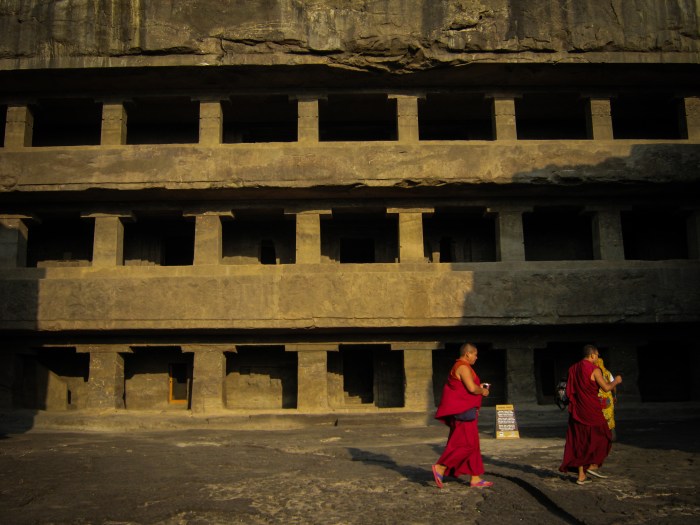
The most remarkable of the cave temples is Kailasha (Cave 16), named for the mountain in the Kailash Range of the Himalayas where the Hindu god Shiva resides. The Kailasha temple is the largest of the 34 Buddhist, Jain and Hindu cave temples and monasteries known collectively as the Ellora Caves, ranging for over 2 kilometres (1.5 miles) along the sloping basalt cliff at the site.
One can plan the visit of these caves according to the time available and depending upon the interest in ancient art. If a visitor has at his disposal three to four hours, then the Cave nos. 10 (Visvakarma Cave), 16 (Kailasa), 21 (Ramesvara) and 32 & 34 (Jaina group of caves) should not be missed. Thus, by visiting these caves, one can have a glimpse of the representative art of Buddhism, Brahmanism and Jainism.
If a visitor has an entire day at his disposal, the Cave nos. 2, 5, 10 & 12 of the Buddhist group; Cave nos. 14, 15, 16, 21 & 29 of the Brahmanical group and Caves 32 to 34 of the Jaina group should be visited.
Feel Free to enquire for more details by leaving a comment after the page.
 Travel2Xplore